My TpT Store

Showing posts with label behavior management. Show all posts

Monday, December 31, 2018

How to Start Teaching As Soon As Students Enter the Classroom

How can you begin the learning as soon as students enter the classroom?  This post shares my best tips for continuing the learning from one class to another and using every possible minute to its fullest.


How to Start Teaching As Soon As Students Enter the Classroom


Build Relationships First, Even if It’s not the Beginning of the Year

The beginning of the year is a great time to do this, but so is the return from a holiday break or anytime you need to reconnect with your class. 

Each day's warm-up should have something to do with relationship-building at first.  For example:

Monday: a deep breathing exercise/strategy.

Tuesday: students share a place they would travel to and explain why.  Bonus points if it's a place you will be learning about this year.

Wednesday:  Share what's going well and what needs improvement.  It could come in the form of "Two Successes and an Improvement".  Have students start with two things that are going well and give one thing that needs improvement.

Thursday:  What are you curious about?  Let students research and learn more about whatever they are curious about.  Bonus points if it's related to the subject in your classroom.


Friday:  Break out all of those get-to-know-you worksheets from the beginning of the year and start playing games with them.

Here's some things I like to do/revisit those get-to-know-you information you've already gathered:


Get-to-Know-You Name Tags


How to Start Teaching As Soon As Students Enter the Classroom


If the traditional get-to-know-you activities aren't what you're looking for:

Fresh Alternatives to Get-to-Know-You Activities


How to Start Teaching As Soon As Students Enter the Classroom


After Relationship-Building, Focus on Directions


Have the Directions Clearly Displayed for Students as They Enter the Room

Use your Smart Board, projector, doc cam, or simply write the directions on your board.  I like to have them written in a numbered list so students know what to do first, second, and so on.  
This ensures that you are able to do the executive tasks, such as take attendance and get out materials for the next lesson, while students are preparing for learning themselves.

Write/Type These Directions on the Board Before You Leave Each Day

It's the last thing I do each day to prepare for the next day.  If you can't hand write the directions, try typing them and projecting them.  This might actually make it easier and quicker for you and your students.  You can blow up the font and edit it without losing much time.

Make Prep Work Part of the Opening Activity

There are administrative things that need to be done on almost a daily basis.  Getting students to do this on their own at the start of class makes everything go more smoothly and quickly for the rest of the lesson.  Some things I often have students do:
  • Write homework in their agenda
  • Get out papers that I will collect/grade so they are ready to turn in
  • Get papers/materials they will need during the class


After Directions, Decide How You Will Encourage Good Behavior

Incentivize It

Teach them to get to work on it even before the bell rings and give them participation points for doing so.  You can award individual or team points if you have them sitting in teams.  You'd be amazed at how positive peer pressure can make things happen!


Make It Cumulative for the Week

Sometimes the warm-up will be a question on what we learned the day before. Then I have them turn in the whole thing on Friday. This way if a student is absent or needs more time to complete a particular assignment, they do not feel stressed to try to get it done all in one class. 

Go Digital 

If you have to ability to use Google Forms, you can both  assign and instantly assess your warm-up questions and activities.  Here’s is a detailed explanation of how to use Forms to create and assess


Finally, Make It Easier for Students to Continue the Learning on Their Own 

Give Students a Sneak Peak at What They Will Learn That Day 

Having a warm-up activity each day will establish what students are going to be learning and/or extend previous learning through a question, political cartoon, quote, etc.  

Have Students Review Previously Taught Material

This could be material you taught this year, or it could be material that should have been taught last year in your subject area. I will sometimes have students quiz each other on previous test material or study guides during this time.

Vocabulary 

I go through and find the most difficult words from the state test and assign a few at a time.  These are from the unit I’m ABOUT to teach. I only have them do the definition and draw a picture and we go over examples and non-examples as a class. It front-loads the information so students can participate in class discussions in the future.  If you're interested in learning more, check out my Vocabulary Instruction and Assessment packet.


How to Start Teaching As Soon As Students Enter the Classroom: Vocabulary


How do you get students to begin learning as soon as they enter the classroom?  I'd love to hear your thoughts and tips!


Monday, February 26, 2018

How to Reach the “Unreachable” Students

Do you want to increase student participation and assignment/homework completion?  Do you have students who seem impossible to motivate?  Then I have some solutions for you in this post!


How to Reach the “Unreachable” Students


1. Rethink Homework
If homework isn’t getting completed on a regular basis, consider not assigning it. 
Instead:
  • Make all work achievable in class time. 
  • Have them break up information and present it to each other.  Students can complete a graphic organizer as others present. 

You can also read my homework post based on Myron Dwek’s Grading Smarter Not Harder

How to Reach the “Unreachable” Students


2. Rethink Study Guides
  • First, start with the test in mind. Create study guides from the tests. 
  • To help students keep track of them, print them on colored paper. 
  • Have them quiz each other daily on the study guide, even if it’s just a few minutes at the beginning of class. 


3. Rethink Review and Test Prep
Turn it into a game with this Review Games Packet

How to Reach the “Unreachable” Students


If you have access to technology:
 Webquests, edPuzzle, Kahoot (and more) can all add excitement to a class while reviewing content. 

Offer extra credit for thinking outside the box:
I tell them they can add any information not already on the test related to this subject to the study guide for extra credit.


4. Get Them Moving
I give a specific example of this in my post on 22 Interactive Learning Structures 

How to Reach the “Unreachable” Students


Another post I did was based on Rick Wormeli’s Summarization in Any Subject

You can pick up a FREE copy of the Human Bingo board
How to Reach the “Unreachable” Students


Some other good options for getting students standing and moving:
Learning stations
Gallery walks

What are some other ways you reach those students who struggle?  I always need more ideas!


Tuesday, January 2, 2018

Classroom Management Series: Restroom Usage Policy

Are you looking for some time-tested, evidence-based ways to enhance your classroom management?  My post on creating a restroom usage policy will guide you through the steps to help you decide if you need a restroom usage policy and how to implement one!


This is the fourth post in my Classroom Management Series.  If you missed it, be sure to check out the previous posts:
Teaching Expectations After the Year has Started


Classroom Management Series: Restroom Usage Policy


First, let me say that this is one of those tough situations because no one wants to restrict bathroom usage. 

Students should be able to use the restroom whenever they need to, right?  Yes, but that doesn’t mean we can’t guide students with some good classroom management!

Step 1: Make Sure It’s Not a Medical Issue

If you notice the same students going to the restroom over and over, ask the school nurse if there’s anything medically relevant that you should know about the student in relation to bathroom usage.  If not, the nurse might want to call home and make sure the medical records aren't missing some important medical information about the student in that area.  

Step 2: Talk to Students Individually 

Have a conversation with the students who go at the same time consistently and make a plan for what they need to be successful.  Sometimes just a chat with the student will clear things up.

Step 3: Don’t Restrict Restroom Use at All, But Still Have Policies in Place. 

For Example:


  • Whenever possible, have students go between periods. 
  • Alternatively, have them ask to use the restroom as soon as they come in the room. 
  • If a student must go after class has started, they can go with a pass as long as it's during their independent work time. 
  • Make sure students leave their cell phone with the teacher when they leave to use the restroom.

What if you've tried all this, but it's still not working?

Keep a Log of When/Where/How Long a Student Uses the Restroom

If, however, students are roaming the hallways or abusing their restroom privileges, then you might want to keep a log of when/how long they are gone and when they return.  This is an excellent tool to share with parents and your colleagues so that everyone is on the same page.  


Before reading the next part, I urge you to read this article, written by a pediatric urologist about restricting restroom usage.


Use a Punch Card

Some schools have a school-wide pass that students get every nine weeks.  It’s a punch card with two punches per class.  A nice behavior management technique to go with this is allowing students to “purchase” additional out of class passes with classroom incentive “bucks”.  Everyone wins in this case because students have to make good choices in order to earn their bucks to buy extra bathroom or out of class time.

Some Things to Consider Before Using a Punch Card:  


  • What will you do if the students lose their pass?  
    • Will you enforce the policy that they won’t be able to leave class?  
    • Will you have them “buy” passes as a backup in that case?
  • What if students don't use all their punches?  
    • Can they turn them in for extra credit or classroom privileges?

Do you do anything else regarding your restroom usage policy?  This is one of those subjects I can't ever learn enough about, so please share your thoughts and tips with me!


Monday, December 25, 2017

Classroom Management Series: How to be a Classroom Leader Instead of a Boss

Are you looking for some time-tested, evidence-based ways to enhance your classroom management?  Would you like to be a leader, rather than a boss in your classroom?  Then my post on how to be a classroom leader is for you!

This is the third post in my Classroom Management Series.  If you missed it, be sure to check out the previous posts:
Teaching Expectations After the Year has Started


Classroom Management Series: How to be a Classroom Leader Instead of a Boss


Consistency is Key
Be consistent with rules across the board.  If there's one thing a middle-schooler can spot, it is inequity in how rules are applied.  Students like to see consistency and fairness.  Students like structure. Enforcing rules doesn't make you mean. Two things that I want students know: I care about them and I mean business.

Some things I'm consistent about:

  • Don't start any directions or activities until every student is quiet and has eyes on you. 
  • Before letting them touch any materials, review expectations or directions.  This even applies to tests. 
  • Don't be afraid to completely stop everything if you feel like it is spiraling out of control. Sometimes a few minutes of silent reflection as a class is all that's needed for everyone to return to the task at hand with fresh eyes.


Even Though Consistency is Key, It is OKAY (even wise) to start over with your expectations if things aren't going well. 
The advice I gave in my post about Teaching Expectations After the Year has Started was to start over after the new quarter begins.You may want to start by writing down procedural expectations for things like turning in papers, using supplies, etc. If you've already written these expectations down, review them and make sure they are still working for you and the class.    


Review Expectations Often
Quickly reviewing your classroom expectations before your class is expected to work independently on something will help students who are auditory learners.  Also, reviewing expectations often, especially after holiday breaks, is a key to success.


Try Some Professional Development
Leaning and reflecting will make you a better teacher almost instantly.  Ask your administration if you can get coverage for your classroom so you can go into some well-run classrooms to observe and take notes.  I love learning from teachers who just seem to flawlessly execute classroom management! 

It's important to remember:  The fact that you are asking for help shows great courage and desire to be a good teacher.


Build Relationships With Students
  • Write down their birthdays
  • Talk to students and remember details about their life.  Ask them about it the next day! 
  • Smile at them and chat with them whenever possible (in the hallway, in the lunch room, etc.). 
They are a thousand more times likely to want to learn from a teacher that cares about them and their lives!


Target Problem Students... in a Good Way

Try the 2x10 activity- Pick out a student with whom you are struggling. Find 2 minutes to chat with them in the day about nothing class-related. Do this for 10 days in a row. It be awkward at first, but by the 3rd or 4th day, they will look for you and look forward to it. After 10 days, choose another student.

I believe this is the single, most important thing you must do to be an effective teacher. It doesn't take much...anything to show you care. Make sure you try hardest with the most difficult students. They are the ones that need it the most! Be sincere and be interested in them.


Relax a Little

I am a Type A person and have to rein it in. Decide which behavioral expectations must stay and which do not matter. The fewer things you hold fast to, the easier it may be for students to live up to your expectations and not feel like they are being micromanaged.

Let them know you’re approachable and down to earth. Show them a sense of humor by being able to laugh with them.


Have Something for Students to be Doing From the Moment They Walk in the Door
It establishes the tone and expectation for the class, as well as getting students to think about the curriculum.  Every day in my classroom, there is a numbered list on the screen the second the students walk into the room. As students trickle in, they immediately begin to complete the list, which almost always starts with filling out their agenda.  As I take attendance and check homework, they are engaged in completing the list.

Alternatives to the itemized list (all posted on the board for the students as they arrive):

  • A bellringer 
  • Daily review question
  • Entrance ticket 

Join me next time, when I'll be continuing my Classroom Management Series with a complicated issue:  Restroom Usage Policy.


Monday, December 18, 2017

Classroom Management Series: Strategies for a Chatty Class

Are you looking for some time-tested, evidence-based ways to enhance your classroom management?  Would you like to calm a chatty class without having to resort to threats or punishment?  Then my post on how to calm a chatty class is for you!

This is the second post in my Classroom Management Series.  If you missed it, be sure to check out the first post:
Teaching Expectations After the Year has Started


Classroom Management Series: Strategies for a Chatty Class


The To-Do List

Teach Students the Difference Between Class Discussions and Group Discussions
There's a time to talk, and there's a time to listen.  Students need to be explicitly taught what your expectations are for those times.  Just because a student "should know" the difference doesn't mean that they do.  My rule is that when I'm teaching the whole class, there is no talking until I tell them to turn and share with their group/partner.  When I'm talking, their only job is to listen.

Use the "Stand-in-the-Front-Quietly-Until-Everyone-Quiets-Down" Technique 
This can work wonders, especially if you've tried to ignore the talking in the past with poor results.  Positive peer pressure will often kick in when a few students realize you're waiting and begin to shush their counterparts.

Try a Visual Cue:  When Arms Go Up, Voices Go Down 
Teach students that when you raise your hand, you need them to be quiet. When they see you with your arm raised, they should also raise theirs, get quiet, and be ready to listen.

Try an Audible Cue:  Count Down
Start counting down from 5-4-3-2-1.  Once again, positive peer pressure should kick in once students realize you are counting.

Select a Period of Time During Which There is No Talking
It could be the first or last five minutes of class or while you are teaching the whole group.  This helps establish boundaries for when it is appropriate to talk and when students need to be listening.  As an added incentive to be quiet during this time, I play instrumental music if it's independent work time.  It helps set the tone as a "serious study time".

Once Students are Quiet, Thank Them for Being Respectful. 
Let them know you will always give them your whole attention, as they are worthy of respect.  This is part of relationship-building, and showing students respect goes a long way towards improving classroom behavior.

Start Whispering
I have found that if I lower my voice and speak in a quiet voice, students notice the difference much more quickly than if I raise my voice to try to talk over top of them.  When I was an elementary teacher, I used the "If you can hear my voice, clap once" strategy.  Now that I'm a secondary teacher, I say "If you can hear my voice, you should be encouraging those around you to SLANT".  As part of my beginning of the year practices, I teach students to:
Sit up
Lean in/Look interested
Ask question
Nod
Track the speaker


The Don't-Do List

Raise your voice to quiet students. 
You will get louder and they will get louder in response.  This is the opposite of what we're going for.

Allow Talking Across the Room Unless It's Class Discussion Time
I make sure to stop talking/teaching every time it happens because it quickly turns into a free-for-all.  Students need to raise their hand in my class and be called on before talking, so I simply stop the students who are talking across the room by reminding them that they need to stop and raise their hand before speaking. I also don't try to talk over top of them.  I just stop and look at them until I have their attention.


Closing Thoughts
Not all of these techniques will work for every class, so don't lose heart if you have to try a few of them out before you find one that works.

You might have to review these expectations often, especially after holiday breaks.


What works for you when it comes to quieting a chatty class?  I'd love to hear about it!


Monday, December 11, 2017

Classroom Management Series: Teaching Expectations After the Year has Started

Are you looking for some time-tested, evidence-based ways to enhance your classroom management?  Would you like to reinforce your existing classroom management techniques or start over from scratch?  Then my post on enforcing expectations after the year has started is for you!


Classroom Management Series: Teaching Expectations After the Year has Started


This is the first post in my Classroom Management Series, so I wanted to tackle something that I hear about a lot from ALL teachers, whether they are seasoned or brand new:

  • How do I reinforce my classroom expectations midway through the year?
  • Can I wipe the slate clean and start over if things aren't going well?

Let me share my strategies/answers to these questions with you!

Strategy #1: Start the New Quarter Like it's a New Year
I’ve had veteran teachers tell me they start off new grading periods and returns from breaks as “first days of school.”  There are several reasons why this is ideal:
  • Even the most well-behaved classes need a refresher course on behavior expectations after holiday breaks or report cards.
  • This is the perfect time to throw out any procedures that aren't working for you or your class.
  • Seasoned teachers know that they can change, reset, and modify expectations ANY time.  
New Quarter Actionable Tip 1: Give Reflection Surveys
Give an end of quarter reflection/survey so you can gather some information from them and then implement changes based upon the results.

Reflection survey questions should be specific to what happened in the past quarter:
How do you feel about your performance and what can you improve?
What is one thing you would like to see different in the new quarter?

New Quarter Actionable Tip 2:  Create a New Classroom Constitution
Liken the need to revamp expectations to amending the Constitution. Not everything works how you'd thought!

Create a new class constitution based on what worked/didn't work.The responses to your reflection survey can guide this process.   You might ask students to write what success looks like in class, how the teacher should communicate success, and what rewards and consequences they would prefer. Together, you can then write out an agreement that is signed by the students, parents, and teacher.

New Quarter Actionable Tip #3: Choose the Top Three Problems and Explicitly Teach/Reteach Your Procedures for Dealing With These Problems
One of the most important classroom procedures that I rely on constantly is SLANT. When I say “SLANT”, students know to close their devices, put their pencils down, stop talking, and look at me. 

Below is an example  SLANT poster from Whooo’s Ready to Teach? blog.


Strategy #2: Be Honest About What Went Wrong
If you started off too nice, just be honest with them. The conversation might go something like this:
"I am concerned that the original management plan isn't working. Students aren't in the right position to be the best learners they could be and we need to change some things to help you be more successful." Then, implement the new rules.


Strategy #3: Talk to Your Colleagues 
It might be time to involve your grade-level counterparts to come up with expectations, consequences, and incentives for the entire grade level.  The new quarter is a great time to introduce these.


Strategy #4:  Keep Building Relationships With Students 
Nothing helps to manage a classroom more than talking to kids one on one privately, encouraging them to step up and be a leader and extricate themselves from the talkers and disrupters, in conjunction with a classroom plan. It helps them know you care too.


Strategy #5: New Seating Chart 
You know the allies and axis now.  Reward the Middle, replace the distractions

Seating Chart Actionable Tip 1: Seat Students in a Boy-Girl Pattern
While this might seem counter intuitive, especially in middle or high school, it really does cut down on the talking. 

Seating Chart Actionable Tip 2: Change the Desk Arrangement 
If the problem is too much taking, try rows or a horseshoe setup.  If you need to encourage talking, try pods of 3-4. 


Strategy #6: Reach Out to Parents
Start by identifying three students in each class who are the most disruptive, call their parents and tell them what's going on, and ask how you can work with them to improve their child’s' behavior and attitude. If need be, focus on three more kids whose parents need to be contacted.


Join me next time, when I continue my behavior management series with "How to be a Leader, Not a Boss".


Sunday, August 30, 2015

Behavior Management Cards

I am a big believer in having a behavior management system that allows some flexibility for the teacher, as well as give multi-sensory cues to the student.

In middle school, I knew a clip chart wasn't going to fly. So I created a card reminder system. 


While creating the cards, I thought of three main behaviors I wanted to see. These were: Teamwork, hard work, including staying on task, and evidence of higher-level thinking. I named these "Praise Cards". 


Then, I thought of the three main behaviors I wanted to curb. These were: Talking at inappropriate times, off-task behaviors, and leaving the group or their seat at inappropriate times. I named these "Reminder Cards".  


If I see a desired behavior, they get a Praise Card to keep for the period.  At the end, they write their name on a slip of paper to be entered into a drawing for prizes.  I plan to draw names about once every month or so.

If I see negative behaviors, I give a verbal warning first.  If the behavior continues, I give the Reminder Card.  If it still continues, I give a written referral (our school policy).  I find that having a reminder in front of them usually curbs the behavior for the period.

I made a PowerPoint of the cards so I could print as many as I needed.
This editable PowerPoint includes:
~4 "Reminder Cards" for talking
~4 "Reminder Cards" for off-task behavior
~4 "Reminder Cards" for being out of seats
~4 "Praise Cards" for teamwork
~4 "Praise Cards" for hard work
~4 "Praise Cards" for higher-level thinking

If you want to pick up a copy, click here.

Do you use a card system in your classroom?  I'd love to hear how!

Sunday, August 24, 2014

Building a Classroom Community Using Author's Purpose

I have always used author's purpose (PIE) when teaching reading and writing. We talk about the "slices of pie" (persuade, inform, entertain) that authors use, depending on what they want their readers to take away from the text.  We practice these same techniques in our own writing, carefully choosing our words to fit our purpose.  I have posters displayed around the room and in reference guides at group tables.

There are a ton of great visuals and practice activities out there, but here are just a few of my favorites:


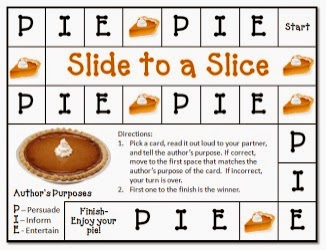
This is a great board game for practicing identifying author's purpose, not to mention it's FREE!


Then there's my favorite visual of Author's Purpose from Mrs. Gilchrist:


I do these things every year but THIS year, I'm turning the lesson around for the students to take charge.  After teaching the basic pieces of the P.I.E., I am going to open up the journaling to my student authors.


 In order to build the classroom community aspect of the journal, I will be including story starters and examples that support social problem solving in school and the classroom.


If you teach author's purpose AND you want to work on student journaling AND building your classroom community, then check out this packet on my TpT store
This editable PowerPoint includes:
~Teacher's directions on how to use the product
~Student directions on how to use the product
~Persuasive story starters and examples
~Informative story starters and examples
~Entertaining story starters and examples
~The examples for each section are geared toward building your classroom community and fostering deeper thinking


Do you have any other ways to use P.I.E.?  I'd love to hear about them!


Sunday, May 26, 2013

Thinking Ahead... Table Points

Next year, I'd like to change up my behavior management strategies.  I've begun thinking about it so that I can gather some things from my classroom to take home as I plan.

I've been reading Building Literacy in Social Studies (see the picture below or click on the link).
  What does that have to do with behavior management, you ask?  Well, this book is not only rich with ideas on improving comprehension in Social Studies, but also includes some great ideas how to get small groups of students to work together in the most efficient manor.


This book calls it PODS (Performance Organizational Design System) rather than Table Points, but I think I will stick to calling them Table Points for now because students have background knowledge of that terminology from previous classrooms.

Each student within a table is assigned a number that corresponds to task they will have to complete during the learning block.  For example, all number ones are the group leaders.  The numbers are randomly assigned by handing out index cards with Social Studies terms written on one side and a number on the other.  For example, while studying the Civil War, there might be 5 cards that read "industrial," with a number 1 on the back 5 that read "agricultural," with a 2 on the back, and so on until you have enough to give each student a number within their table.

The teacher could ask all the number threes to collect materials for the group, or the number fours to summarize the information their group discussed during think-pair-share.  Since the numbers are constantly changing, no one knows the task for which they will be responsible.  This should help keep them on their toes and engaged!

Now on to the points.  The book assigns points to desired predetermined behaviors.  For example:
No absence: 5 points
1 absence: 3 points
Homework: 5 points
Materials: 5 points
On-task: 5 points
Assignment: 5 points
Behavior: 5 points

Bonus points are awarded for the following.  This helps compensate for missing homework or absences.
Sharing information
Encouraging
Listening
Participating

Points are tallied daily and weekly to help motivate students to do their best.  The book calls this "positive interdependence" (members of a group realize that each must contribute for the sake of others).

I love this idea.  The one thing I wanted to change was how the points are displayed.  Elementary students need visual representations of their effort to help motivate them.  So, I found some great ideas on Pinterest. 

First, this great idea for keeping track the points earned at the end of the day.  It puts the table's desired reward at the bottom of the strip on a sticky note, and the points are shown by moving a paperclip down the strip.  The group earns their reward once the clip makes it to the sticky note.


The next idea comes from Stephanie Moorman.  She uses algebra to have students calculate their table points.  What a great way to get some math in!


Whew!  What do you think?  Do you use anything similar to this?  I'd love to hear some ideas before I get started.

Sunday, March 17, 2013

Restitution Consequences

While aimlessly pinning one afternoon, I came across a post on "Restitution Consequences" for siblings.  Basically, it's a way to teach children to sincerely apologize through acts of kindness related to the thing that got them in trouble in the first place.  For example, if children are being too rough with each other, they will comfort each other until both parties feel better.  You can read the whole article by clicking here.

I then saw another pin about something called a "chore bucket".


Basically, if you don't do your part to help keep the house clean, you have to draw a chore to to make up for it. 

The article and picture got me to thinking.  We are a classroom family.  My students often behave like siblings.  One day they're best buds and the next... not so much.  They choose to do random nice things and sometimes they choose to do things that hurt each other's feelings. 

The combination of the restitution consequences and "chore bucket" seem like a great natural consequence and in my mind.  So I created a list of consequences that would help with consequences and fostering a sense of caring and community at the same time. 


I'd love to hear if you do something similar with your kids at home or in the classroom!


Saturday, April 21, 2012

Classroom Behavior Chart Freebie

This is a chart to keep track of positive points students earn, and "Yikes!" points for negative behaviors.  I have my students "pay back" the Yikes! with a positive behavior that cancels out the negative. 


Each of the 4 pages can be laminated and attached to each other to create one poster.  The lines in the chart don't show up in the previews on TpT, but the document itself looks exactly like what you see above.

You can pick up a FREE copy at my TpT store by clicking here.

Saturday, March 10, 2012

Behavior Management 2.0

I began the year with the following chart laminated and taped to the top of each students' desk.

I use a Sharpie to mark the good and bad choices under the appropriate column.  All I have to do is use some rubbing alcohol to remove the Sharpie, and the chart is good as new. 

For the past 3 years, this has worked like a charm.  Until recently, when a self-incriminatingly honest child told me that the students had figured out how to use their dry-erase markers to erase the Sharpie.  Huh, you don't say.  Who'd have thought?

After I got over the fact that this class has some major dishonesty issues, I was compelled to come up with a different method.  I thought back to my student teaching days.  My cooperating teacher used colored poker chips to tell the level of warning the student was on.  Green was good, yellow was "warning," and red meant "consequence."  Each one was attached to the desk with poster putty.  If a chip needed changing, the student had to bring it to the teacher and exchange it for the next color.

These are $15.50 for 600 (100 of each color).  I'll only be using the green, yellow, and red for the behavior management.  I can use the other colors as counters or game pieces.  The cool thing is that they are stackable.

I also recently came across a post that inspired me on Dandelions and Dragonflies blog:
She had a file folder with a chart of expected behaviors stapled inside.  If the student is not exhibiting an expected behavior, they "pull their folder."  The teacher puts a check beside the behavior and sends a report home at the end of the 9 weeks.

I think I will use her file folder idea along with the chips for a visual reminder for the student.  I will also be continuing my "Weekly Progress Report" (see below).  My parents tend to want to know more often than just report card time.  I can add any behavior concerns to that.


Saturday, February 18, 2012

Behavior Management Time

Well, the treat basket is gonezo. 

In my classroom students earn points for being caught doing something good, which they can then turn in for rewards of their choice.  Up until this week, the treat basket has been the reward of choice.  Then, due to some dishonesty issues, I had to take the treat basket away.  It's just as well because I was feeling that they weren't really motivated by it anymore.  So now, I have to find something else to make them want to make good choices. 

As it so happens, DonorsChoose is having a matching campaign coming up in March.  So I pulled up the list of accepted vendors and started browsing.  Here's what I came up with:

Physio-Gymnic Balance Therapy Balls - 12" (30cm)

At about $13 a piece, these would be a great deal!  I've read several articles about the health and behavior benefits of using these in the classroom.  Ideally, I'd like 3 or 4 and just rotate them around the classroom each day to the students that earned that reward, but I'm also thinking about storage issues.


Maybe it's the cold weather and lack of sunshine.  Maybe it's the fact that it's "crunch time" and we're learning as much as we can a quickly as possible.  Whatever the reason, some of my students have developed a temper (slamming things, lashing out at classmates, breaking things on purpose).  Perhaps these would help?


Good time management = better behavior, right?  The overhead timer would help whole class assignments and with transitions as well.  The small timer would help with partner work and silent reading.