I cannot express how much I love hundreds charts. Adding, subtracting, multiplication, division... It's the Jack of All Trades!
You can find great hundreds charts all over the place. For this post, I'm using this chart from Elementary Organization. After becoming comfortable with the chart, I eventually have the students draw their own. The reason? Students can always draw a hundreds chart, but I can't provide them with one for state tests.
Now, on to the math.
Rounding and Dividing
I have the students use compatible numbers to round 94 divided by 3 (95 divided by 5).
Use hundreds chart to skip count by fives until quotient (95) is reached. You can skip count by 5s 19 times to get to 95.
So, the answer/quotient is about 19.
Now, to do the actual problem.
The real question is: How many groups of 3 are there inside of 94?
There are 31 groups of 3, with 1 leftover (remainder).
Obviously, this only works up to 100 unless students add on to the chart. So this is really more of an introductory or review activity.
Do you use a hundreds chart for division? I'd love to know how!
Sunday, January 26, 2014
Monday, January 20, 2014
Author Study/Genre of the Month: Deborah Wiles
In the past couple of years, I have started to do a "genre of the month" during reading class. This is loosely based off of The Book Whisperer. By the way, it is a fantastic and quick read that you won't regret buying. I highly recommend it!
February's author is Deborah Wiles. The genre of the month is Historical Fiction, and Wiles has written several books about the 50s/60s that are kid-friendly. I got to meet Wiles at a children's book conference a few years ago. She's knowledgeable and friendly, and it comes through in her books.
As with the other months, I put out a bunch of his books to be displayed for the entire month and I choose one to read aloud. For Wiles, I like to read aloud Freedom Summer. This is a shorter picture book, but it's great for digging deeper into the integration issues of the 50s/60s.
February's author is Deborah Wiles. The genre of the month is Historical Fiction, and Wiles has written several books about the 50s/60s that are kid-friendly. I got to meet Wiles at a children's book conference a few years ago. She's knowledgeable and friendly, and it comes through in her books.
As with the other months, I put out a bunch of his books to be displayed for the entire month and I choose one to read aloud. For Wiles, I like to read aloud Freedom Summer. This is a shorter picture book, but it's great for digging deeper into the integration issues of the 50s/60s.
I also have websites available for students to research Deborah Wiles and find more books that they want to add to their "To Read" lists. Harper Collins Publishers has this website called the Author Tracker and Reading Rockets has many more authors on this site.
Do you have a genre of the month or an author study? I'd love to hear what you do with yours!
Sunday, January 12, 2014
Digging Into the Declaration of Independence
We have begun our unit on the Charters of Freedom (the Declaration of Independence, the Constitution, Bill of Rights, Virginia Declaration of Rights, and the Virginia Statute for Religious Freedom). We discussed the Declaration of Independence in our previous chapter, but we often have to review the details and meaning of the document.
In the spirit of review, I'm combining a couple of my old posts that have inspired me to combine reading comprehension strategies in this unit.
First, Close Reading.
I find that you can copy the text and have them annotate, or you can use page protectors over the text and use dry erase markers to annotate.
Second, textmapping. This is similar to Close Reading, but it has the students annotating together and all the pages are copied, taped together, and laid out so students can view the entire selection at once.
I made a PowerPoint that goes into detail on this and other nonfiction comprehension strategies. You can pick up a free copy by clicking here.
Some suggested resources for reviewing the Declaration of Independence:
This is a magazine similar to Time for Kids, but it's all about certain subjects (the Declaration in this case). It's not free, but it's worth a look. Check it out by clicking here.
You could do this with just about any book, but it definitely works best with nonfiction.
Do you have any books or resources for teaching The Charters of Freedom?
In the spirit of review, I'm combining a couple of my old posts that have inspired me to combine reading comprehension strategies in this unit.
First, Close Reading.
I find that you can copy the text and have them annotate, or you can use page protectors over the text and use dry erase markers to annotate.
Second, textmapping. This is similar to Close Reading, but it has the students annotating together and all the pages are copied, taped together, and laid out so students can view the entire selection at once.
I made a PowerPoint that goes into detail on this and other nonfiction comprehension strategies. You can pick up a free copy by clicking here.
Some suggested resources for reviewing the Declaration of Independence:
This is a magazine similar to Time for Kids, but it's all about certain subjects (the Declaration in this case). It's not free, but it's worth a look. Check it out by clicking here.
You could do this with just about any book, but it definitely works best with nonfiction.
Do you have any books or resources for teaching The Charters of Freedom?
Sunday, January 5, 2014
Long Division Videos and Games
Wow. Long division is always one of those things that takes numerous resources and practice to master. This year, I've added some new videos for my anticipatory sets and review. I've also found some websites and games that
Introducing long division
Anticipatory Set for introducing division with base ten/place value blocks:
This video from Education Unboxed is a fantastic way to introduce long division using place value blocks as arrays. I had never thought to do this before! Considering we just finished our unit on arrays as they apply to multiplication, this was a natural first step.
This video from Nextvista shows a group of students incorporating kinesthetics into their long division by doing a dance with different movements to go with the steps to long division. Then there's a video actually doing the steps on paper.
Another video incorporating kinesthetics and a rap.
This video shows how to front end estimate long division problems.
Practicing Facts
Sum Sense Game that gives three numbers and has students drag and drop them to create division facts.
Division Machine Game
Reviewing long division
Fun4thebrain games
Division hidden number game: You can differentiate the numbers so that there are remainders. The problem will either give the quotient, divisor, or dividend and the student has to fill in the missing number.
So, this is the first couple of weeks of our long division unit. Obviously, there's a ton of practice and review needed. Do you have any other resources for introducing or reviewing long division? I could use all the help I can get!
Introducing long division
Anticipatory Set for introducing division with base ten/place value blocks:
This video from Education Unboxed is a fantastic way to introduce long division using place value blocks as arrays. I had never thought to do this before! Considering we just finished our unit on arrays as they apply to multiplication, this was a natural first step.
This video from Nextvista shows a group of students incorporating kinesthetics into their long division by doing a dance with different movements to go with the steps to long division. Then there's a video actually doing the steps on paper.
Another video incorporating kinesthetics and a rap.
This video shows how to front end estimate long division problems.
Practicing Facts
Sum Sense Game that gives three numbers and has students drag and drop them to create division facts.
Division Machine Game
Reviewing long division
Fun4thebrain games
Division hidden number game: You can differentiate the numbers so that there are remainders. The problem will either give the quotient, divisor, or dividend and the student has to fill in the missing number.
So, this is the first couple of weeks of our long division unit. Obviously, there's a ton of practice and review needed. Do you have any other resources for introducing or reviewing long division? I could use all the help I can get!
Sunday, December 29, 2013
Mixing Weather and Prepositions
We've been learning about cloud types in Science and we're constantly reviewing grammar. So, it's always nice when we can combine the two.
First, here are some great ideas for differentiating between the cloud types:
A cloud flip book from Crazy for First Grade blog.
Take the kids outside to identify what's in the sky with this cloud viewer from Nature Watch.
Make a cloud strip that lists the different cloud types by altitude. This came from The Inspired Classroom blog.
After introducing the cloud types and their altitudes, we reviewed prepositions. Then we watched a cloud-preposition video.
As an extension, we did the following activity:
First, here are some great ideas for differentiating between the cloud types:
A cloud flip book from Crazy for First Grade blog.
Take the kids outside to identify what's in the sky with this cloud viewer from Nature Watch.
Make a cloud strip that lists the different cloud types by altitude. This came from The Inspired Classroom blog.
After introducing the cloud types and their altitudes, we reviewed prepositions. Then we watched a cloud-preposition video.
As an extension, we did the following activity:
Have students draw, label (name of cloud and
prepositional phrase of position in sky), and cut out a shape of one of the
clouds: Choose one of the three main
types of clouds (cumulus, stratus, cirrus).
·
Have them write about what the presence of the
cloud means for the people on the ground (weather conditions).
·
When
all the clouds are ready, tell your little meteorologists to put their heads
down and hang out at their desks.
·
Play music while students
hide their clouds around the room.
·
Have
each child one at a time go hide their cloud somewhere in the classroom. When
they are done, have them tap the next student on the shoulder.
·
Have
the students write sentences, using prepositions, describing where they found
or hid their objects. Example: The
puffy cumulous cloud was hiding UPON the sunny window sill
OR I found my plump cumulous cloud hiding BENEATH a hefty stack
of chairs. This is also a great lesson on word choice and
adding DETAILS to your writing.
How about you? Have you combined some Science and grammar in your classroom?
Sunday, December 8, 2013
Polar Express Day
Our school celebrates Polar Express Day. We try to make the whole day about it, including the core subjects. Here are some of my brainstorm ideas for this year:
Math:
This idea comes from a post from Little Miss Glamour Goes to Kindergarten. I would adapt it for fourth grade by having students create repeating as well as growing geometric patterns with the confetti. I love that she has them use paint brushes for the glue and keeps the different patterns separate in an art tray. I found some cute snowflake confetti, winter foil confetti and poinsettia confetti for this purpose. I also found a blank ornament coloring page for the outline.
The next graphing activity was inspired this post on Celebrate Second Grade blog. She has them taste test different flavors of candy canes and then graph the results. I found an assortment of mini candy canes here.
I found a great candy cane graphing activity on TpT that has students using tally charts, frequency charts, bar graphs, and picto graphs.
Social Studies/Language Arts:
I found a great map skills activity called "See the World With Santa" on TpT. It has students use a map, atlas, or globe to research cities by longitude and latitude that Santa would fly through.
Writing:
I have a winter poetry unit on TpT in which I have students write haikus and make snowflakes. I found a better way to make the snowflakes out of coffee filters in this blog post. I think I would still teach students how to write the winter haikus and try the coffee filter snowflakes.
We're supposed to do "step-by-step" writing in fourth grade, so I was happy to find this "How to Make Hot Chocolate" FREE activity on TpT from Third Grade Bookworm.
Science:
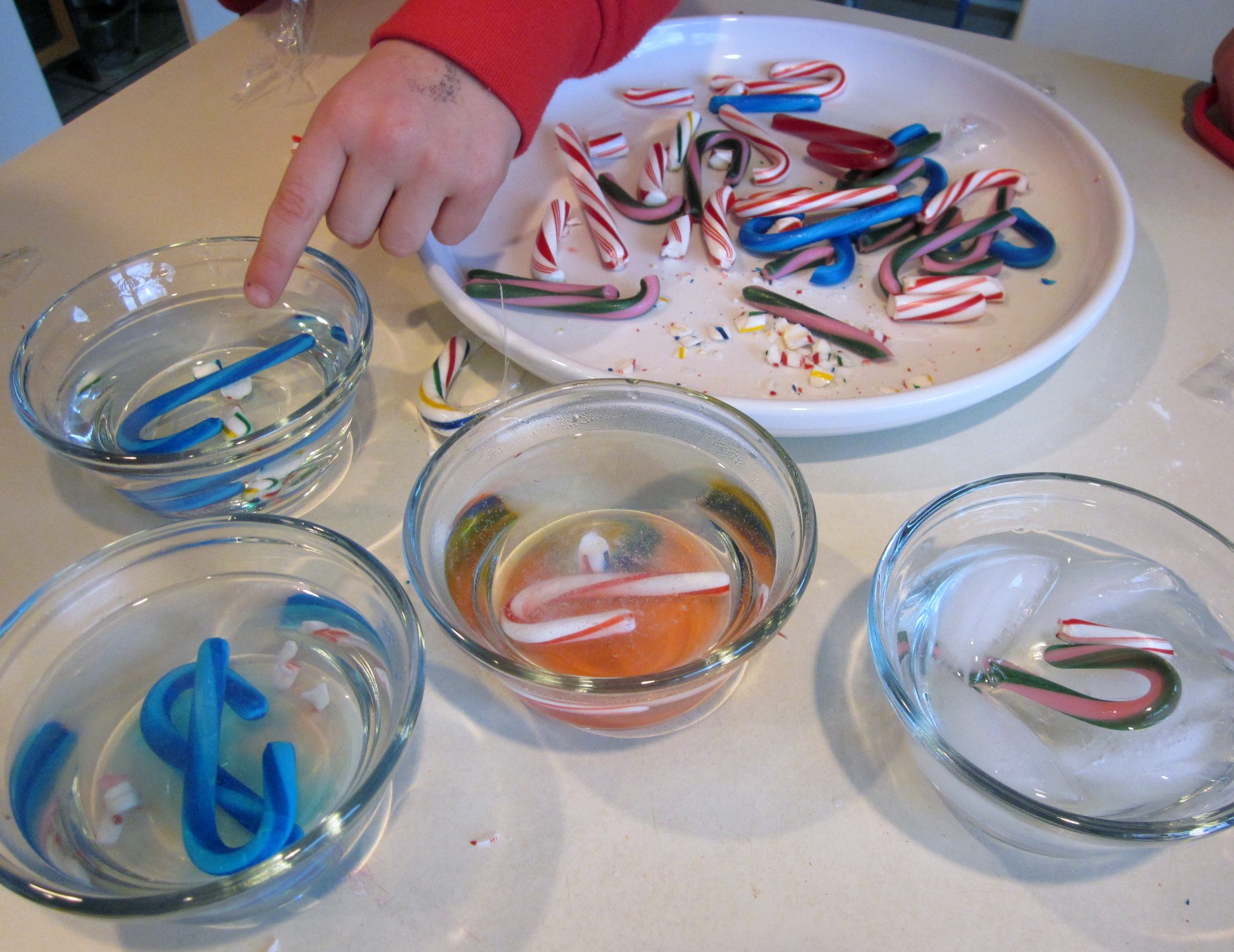
I was inspired by this post by Teach Mama on experimenting with candy canes. She had her kids test the canes in different liquids: Hot water, warm water, freezing water, and vinegar.
I would have them complete the Scientific Method foldable we've been using since the beginning of the year.
So with that, I'm at the end of my brainstorming! Do you do any upper grades activities to celebrate Polar Express Day? I'd love to hear what you do!
Math:
This idea comes from a post from Little Miss Glamour Goes to Kindergarten. I would adapt it for fourth grade by having students create repeating as well as growing geometric patterns with the confetti. I love that she has them use paint brushes for the glue and keeps the different patterns separate in an art tray. I found some cute snowflake confetti, winter foil confetti and poinsettia confetti for this purpose. I also found a blank ornament coloring page for the outline.
The next graphing activity was inspired this post on Celebrate Second Grade blog. She has them taste test different flavors of candy canes and then graph the results. I found an assortment of mini candy canes here.
I found a great candy cane graphing activity on TpT that has students using tally charts, frequency charts, bar graphs, and picto graphs.
Social Studies/Language Arts:
I found a great map skills activity called "See the World With Santa" on TpT. It has students use a map, atlas, or globe to research cities by longitude and latitude that Santa would fly through.
Writing:
I have a winter poetry unit on TpT in which I have students write haikus and make snowflakes. I found a better way to make the snowflakes out of coffee filters in this blog post. I think I would still teach students how to write the winter haikus and try the coffee filter snowflakes.
We're supposed to do "step-by-step" writing in fourth grade, so I was happy to find this "How to Make Hot Chocolate" FREE activity on TpT from Third Grade Bookworm.
Science:
I was inspired by this post by Teach Mama on experimenting with candy canes. She had her kids test the canes in different liquids: Hot water, warm water, freezing water, and vinegar.
I would have them complete the Scientific Method foldable we've been using since the beginning of the year.
So with that, I'm at the end of my brainstorming! Do you do any upper grades activities to celebrate Polar Express Day? I'd love to hear what you do!
Sunday, December 1, 2013
Monitoring Understanding While Reading
We have been working on Monitoring our Understanding while we read lately. In an effort to combine previous strategies we learned during our "Fix-Up Strategies" unit, I created an organizer that mentioned the most pertinent strategies (in my humble opinion).
This organizer asks students to monitor their understanding while they read. When they come to a word, sentence, or phrase that confuses them, they use a strategy to clarify their misunderstanding. The organizer lists several examples of strategies students may use, but I never limit them if they choose to use one that is not listed.
You can pick up a free copy by clicking here.
Now, for some suggested mentor texts because I would much rather use picture books when I'm first introducing an organizer!
This is a great text to model how readers need to closely observe and integrate what is happening in both the pictures and the words.
This organizer asks students to monitor their understanding while they read. When they come to a word, sentence, or phrase that confuses them, they use a strategy to clarify their misunderstanding. The organizer lists several examples of strategies students may use, but I never limit them if they choose to use one that is not listed.
You can pick up a free copy by clicking here.
Now, for some suggested mentor texts because I would much rather use picture books when I'm first introducing an organizer!
This is a great text to model how readers need to closely observe and integrate what is happening in both the pictures and the words.
Use this book to model how to decode a multi-syllabic word and how to use context to determine the meaning of an unknown word. You will authentically need to model rereading to understand!
Now, I'm sure there's a ton of great mentor texts out there for this strategy. I would love to hear your suggestions!
Subscribe to:
Posts (Atom)