My TpT Store

Sunday, October 30, 2016

Reading Comprehension Bookmarks: An Alternative to Reading Logs

Would you like:
1.  A quick and effective way to involve parents in nightly reading?
2.  An alternative to a reading log that still holds students accountable for what they read? 
3.  A supplement to your current reading log that keeps things fresh?

I if you answered yes to any of these questions, then Reading Comprehension Bookmarks are for you!


Reading comprehension bookmarks: An alternative to reading logs.


I came up with this idea when parents were asking me for an alternative way to assess their child's nightly reading comprehension, rather than just signing the Reading Log. I sat down and thought about the core questions that would demonstrate an overall understanding of any text. This is how my Reading Comprehension Bookmarks were born.

Using the bookmarks instead of a Reading Log:

I have parents choose 2 of the questions on the bookmark to ask their child each night after reading, and write the number of the questions asked in their child's agenda. I ask parents to choose different questions each night, so different levels and concepts of comprehension are tested.

If the reader truly understood what they read, they should be able to answer all of them correctly.  If the reader is unable to answer, they should go back and reread that portion of the text.If the reader truly understood what they read, they should be able to answer all of them correctly.  If the reader is unable to answer, they should go back and reread that portion of the text.

Reading comprehension bookmarks: An alternative to reading logs.


Reading comprehension bookmarks: An alternative to reading logs.


Using the bookmarks with a Reading Log:

I've used them in conjunction with a Reading Log.  In this case, I still have parents sign the reading log and there is a section to indicate which numbers of the questions from the bookmark were asked that night.


Reading comprehension bookmarks: An alternative to reading logs.


I've found both ways to be effective, depending on the needs of the student and parent. This is a great way to differentiate reading comprehension homework. 

If you'd like to pick up a copy, click here.

How do you hold students accountable for their nightly reading? I'd love to hear your tips and tricks!


Sunday, October 23, 2016

Growth Mindset Poster Scavenger Hunt

Would you like to inspire your students to have a Growth Mindset?  Would you like to incorporate movement and collaborative learning into your Growth Mindset lesson?  If so, then this post is for you!

We've been using Mindsets in the Classroom: Building a Culture of Success and Student Achievement in Schools by Mary Cay Ricci in our school and county.  My school is also focusing on getting the students up and moving while learning.  Then it dawned on me:  I should combine the two and do a gallery walk/scavenger hunt!

The Growth Mindset Poster Gallery Walk / Scavenger Hunt starts with 10 growth mindset quotes. 


Growth Mindset Poster Scavenger Hunt.  Growth Mindset famous quotes posters.  Collaborative learning scavenger hunt.


Students walk around the room and answer questions about the posters.  There is an answer key included to make the activity self-checking or for aid in use as a formative/summative assessment.


Growth Mindset Poster Scavenger Hunt.  Growth Mindset famous quotes posters.  Collaborative learning scavenger hunt.
The second poster scavenger hunt focuses on the neuroscience behind having a growth mindset.


Growth Mindset Poster Scavenger Hunt.  Growth Mindset famous quotes posters.  Collaborative learning scavenger hunt.

Some of the posters focus on how to strengthen the brain with food.


Growth Mindset Poster Scavenger Hunt.  Growth Mindset famous quotes posters.  Collaborative learning scavenger hunt.

Other posters focus on the nerve and brain cells.


Growth Mindset Poster Scavenger Hunt.  Growth Mindset famous quotes posters.  Collaborative learning scavenger hunt.


Students are again asked to take a gallery walk and answer questions about the posters.


The entire packet includes:
~10 growth mindset poster quotes, some by famous people
~A scavenger hunt student sheet and answer key for the quotes
~10 posters on how the brain works and how to strengthen it
~A scavenger hunt student sheet and answer key for the brain section of the scavenger hunt


If you'd like to pick up a copy, click here.


Do you have any low-prep, fun activities to teach or reinforce growth mindset?  I'd love to hear about them!


Sunday, October 16, 2016

Storing Station Materials Or Busy Bags

Do you do stations for all or part of your day?  Is it a struggle to keep all those materials organized  Then check out this nifty DIY hanging bag organizer!  

It literally took 30 minutes to assemble.  

Step 1:  Decide how wide and tall you want it to be.  
I put my organizer up on a table so my son couldn't just grab the bags and yank the whole thing down.  So I measured the table top  and made the base about 1 inch less than the table top width on each side.

Step 2: Buy your PVC pipes and connectors at the hardware store based on your dimensions.

Step 3: Cut your pipes.

Step 3: Build!

Step 4: Hang bags with binder clips and rings.


I used binder rings and binder clips to hang the bags.


DIY Hanging Bag Shelf for storing station materials and Busy Bags.


Since some of the items I wanted to put in bags are too heavy to hang with clips and bags, there is a shelf directly above the bags.  This houses two plastic containers: One with a lid, and one open.


DIY Hanging Bag Shelf for storing station materials and Busy Bags.


The picture below shows the shelf with the containers on the shelf.


DIY Hanging Bag Shelf for storing station materials and Busy Bags.


I hang one row in the front and one row in the back.


DIY Hanging Bag Shelf for storing station materials and Busy Bags.


What system do you use to store learning materials and toys?  I'd love to hear about it!


Sunday, October 9, 2016

Fall Writer's Workshop: Show, Don't Tell

Are you teaching a unit on Fall?  Would you like to incorporate Writer's Workshop into your writing curriculum?  Then read this post on how to do both in my Fall Writer's Workshop: Show, Don't Tell!

When you're working on the concept of "Show, Don't Tell" you use a multitude of sensory words instead of those boring, worn out words and phrases, such as "The leaves were pretty".  Instead, you might say, "The golden and scarlet leaves floated on the breeze".   So much more interesting when you say it the second way, isn't it?

 I can think of no better time of year to incorporate sensory writing than Fall.  It's the perfect time to get the kids outside and writing about what their sensory experiences.  I created a Writer's Workshop that centers around this wonderful time of year.

Fall Writer's Workshop: Show, Don't Tell.  Fall Writing choice board.  Fall Writing Graphic Organizer.  Fall mentor text suggestions.

Students choose whether they would like to write about their favorite outdoor setting, a homecoming game, a Fall food, or Fall clothing.  I find that just by giving them choices, they are excited from the start.

I read mentor texts to them that have good examples of sensory words and figurative language.  Students write their favorite examples in their Writer's Notebook as I read to them.  Some of my favorite Fall books are:


Fall Writer's Workshop: Show, Don't Tell.  Fall Writing choice board.  Fall Writing Graphic Organizer.  Fall mentor text suggestions.
Great examples of Fall clothing words.


Fall Writer's Workshop: Show, Don't Tell.  Fall Writing choice board.  Fall Writing Graphic Organizer.  Fall mentor text suggestions.
While it isn't specific to Fall, it does have great food descriptions.

Fall Writer's Workshop: Show, Don't Tell.  Fall Writing choice board.  Fall Writing Graphic Organizer.  Fall mentor text suggestions.
Excellent visuals and descriptions of Fall foliage.


After we've collected some great Fall words and phrases, students work in small groups based on which writing topic they've chosen.  I meet with each group to help them fill out their Fall writing graphic organizer.

Fall Writer's Workshop: Show, Don't Tell.  Fall Writing choice board.  Fall Writing Graphic Organizer.  Fall mentor text suggestions.


We talk about how to write a "Bold Beginning" to hook the reader.  This is included in the Fall Writing packet and in my "Bold Beginnings and Catchy Conclusions" packet.


https://www.teacherspayteachers.com/Product/Fall-Writers-Workshop-Show-Dont-Tell-2820373


As I am working with small groups, the rest of the class is working cooperatively to editing their classmates' paragraphs using a color-coded editing checklist.  


After several rounds of meeting with small groups and revisions, I go over the Fall Writing Rubric individually with each student.  We discuss how I would grade their work and how they would grade their own work, based on the rubric.


Fall Writer's Workshop: Show, Don't Tell.  Fall Writing choice board.  Fall Writing Graphic Organizer.  Fall mentor text suggestions.


If you'd like to pick up the Fall writing packet, you can click here.

I just love writing about Fall!  Do you do writing units about Fall?  How about Writer's Workshop?  I'd love to hear about what you're doing in your Language Arts class!


Sunday, October 2, 2016

Using Sticky Notes for Reading Comprehension

Do you have students track their comprehension while they read?  Do you use Interactive Notebooks?  It's time to combine the two for an interactive, comprehension-packed activity that allows you to track students' thinking during reading with this Sticky Note Comprehension Activity!


Interactive Sticky Note comprehension activity that tracks students' thinking.


This PDF can be turned into a poster or simply printed and stapled into readers' notebooks. It is designed to help readers track their thinking on sticky notes, which in turn, helps the teacher see the areas in which the students need help or have mastered.          

Although this is great for your Language Arts block, why not add a copy of it to your Social Studies or Science notebooks?  There is so much reading comprehension that needs to happen for full understanding in these subjects as well.

You can pick up a copy by clicking here.


Do you already use this or a similar method?  Is there anything you do differently?  I'd love to hear your strategies!


Sunday, September 25, 2016

Growth Mindset, Art, and Science Activity: Brain Hats

Do you want to create or reinforce a strong growth mindset in your classroom?  Do you want to reach multiple learning styles, including artistic and logical?  Then read on to see how I use brain hats to do all this!


At the beginning of the year, we took a get-to-know-you Growth Mindset survey that let students know if their learning style was more right- or left-brain.


Growth Mindset Get-to-Know-You Activity: Are You a Left- or Right-Brain Thinker?


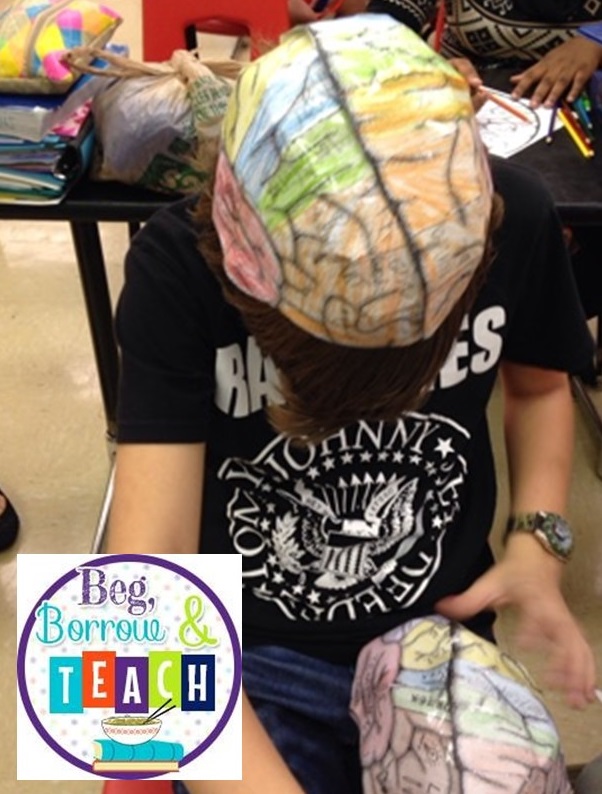
Adding on to the knowledge of the two hemispheres, we recently made "brain hats".   These were inspired by Ellen McHenry's activity. 


Growth Mindset, Art, and Science Activity: Brain Hats.


These hats have all the parts of the brain labeled and list what activities might be associated with each part.  There are different sizes from which to choose. For our middle-schoolers, we used the large/adult size.  There is an option to use smaller sizes for younger students as well. 


Growth Mindset, Art, and Science Activity: Brain Hats.


Students labeled, colored, cut, and taped them together.  


Growth Mindset, Art, and Science Activity: Brain Hats.


This was excellent to use for a Growth Mindset activity because we discussed  how you might have to move outside your comfort zone if you want to strengthen the neural pathways in your brain.  We reviewed what neurons are made of, which we learned about in an activity earlier this year that had us building edible neuron models.


Growth Mindset, Art, and Science Activity: Edible Neurons.


Yes, even middle-schoolers need some growth mindset education.  Actually, this is a crucial age to teach the concepts of neuroscience and grit. This was one of those unique activities that combined art, science, and Growth Mindset all in one. 


What are your favorite Growth Mindset activities?  I'd love to hear about them!


Sunday, September 18, 2016

3 Kingdoms and 6 Domains Differentiated Foldable

Are you looking for an interactive, differentiated way to teach the 3 scientific domains and 6 kingdoms?  Then you need to read on to see how I make a taxonomic foldable for students' notebooks!

I created differentiated pages for students of various learning needs. The one shown below is the fill-in-the-blank version I distribute to most students.  
I differentiate in the following ways:
For students needing a challenge: I have them copy the notes by hand and/or give them copy of the foldable that doesn't have the kingdoms/domains written in.  They must use their resources to find the answers and fill in the blanks independently.  
For students needing extra assistance: I provide them with a completed copy (the answer key) to either copy the answers into the blanks, or to keep and highlight as we go over the answers as a class.


We start by folding a piece of paper in half vertically and hold-punching it (so it will go in our 3-ring binder).  The picture below shows how we cut, arrange, and glue the 3 domains information on the outside cover of the foldable.  


3 scientific domains and 6 kingdoms interactive notebook foldable.  Differentiated fill-in-the-blank.


After the domain pieces are in place, students use their textbooks or online resources to write the appropriate domain in the blanks. 


3 scientific domains and 6 kingdoms interactive notebook foldable.  Differentiated fill-in-the-blank.


Next, we work on the inside flaps.  
First, students glue the 6 kingdoms on the right.  Then, I have students rewrite the domains on the left and draw arrows from the domain to the kingdom under which it is classified.  


3 scientific domains and 6 kingdoms interactive notebook foldable.  Differentiated fill-in-the-blank.


Finally, students write the correct kingdoms in the blanks on the right side of the paper.


3 scientific domains and 6 kingdoms interactive notebook foldable.  Differentiated fill-in-the-blank.


This packet includes:
~Suggestions for how to use the foldable in differentiated instruction
~Step-by-Step directions for completing the foldable
~Pictures for completing each step of the foldable
~Answers written on the picture guide to serve as an answer key

If you'd like to pick up a copy, click here.

Do you teach classification?  Do you have any foldables or interactives you would recommend?  I'd love to hear about what you're using!